Thursday, May 3, 2012

Deadman's Bay Part 1 - John S Mickman


After graduating from the University of Minnesota in the Winter Quarter of 1973, I arrived at one those big decision points of my life; a) I could either search for a job using my Bachelor of Science degree in Business Administration, or b) return to Kodiak, Alaska and get a job on commercial fishing boat.

At that time in my life I really couldn't see myself working in an office as a businessman, and anyway, in the early 70's the country was in a recession and there were not many jobs to be had. Option 'b' was way more appealing, as the previous summer I had hitchhiked to Kodiak, and after many trials and tribulations, had gotten a job on a commercial shrimp fishing boat, The Sogn.  I had really liked fishing and working on the deck of a boat had come naturally to me. I was good at it, and the potential earnings were much more than a young cadet businessman could earn. The other factor was that I didn't have to be a fisherman for the rest of my life; I could be a commercial fisherman for some period of time and then make a career change and put my business degree to work (I hoped!).

And so, on a cold, bleak day in March, the day after my last Final Exam of Winter Quarter 1973, I was back on the road hitchhiking to Seattle where I took a plane to Anchorage, and then on to Kodiak. I had decided that I didn't want to hitchhike all the way to Anchorage because it was still winter in northern Canada and Alaska. Bitterly, dangerously cold. I still thousands of dollars saved from working on The Sogn as a commercial fisherman so I decided that flying was a better option. And, the sooner I arrived in Kodiak, the sooner I could start looking for a job on a boat.

A good buddy from the previous summer, Jacob LeVann, lived in a rental house with his fiancée Mary on the hill (Pillar Mountain) above the harbor. They had extended an invitation for me to stay with them until I was able to get a job and find my own house to rent. Jacob had fished on a boat named The Salu the previous summer, and the Salu and Sogn had fished side by side a few times during the '72 Shrimp Season. The Salu was a bigger, much newer, steel hulled boat, but the Sogn's catch had matched the Salu time and again. Actually, our 3 man crew of Jack the Skipper, Bert Parker and me were always able to get our shrimp on board and our net back in the water dragging along the bottom before the Salu was able to. We really had worked out an efficient deck operation.

Both Jacob and Mary welcomed me with open arms and we all became even better friends. Jacob was looking for a fishing job too, as the Salu had left for the 'lower 48' to get rigged up to fish King Crab that fall. So Jacob and I teamed up and were able to cover all the areas which would likely turn up a fishing job - the harbor, cannery row, the fisherman's bars and marine hardware stores. A couple of fisheries were open including Halibut and Tanner Crab (Snow Crab), and shrimp season was just around the corner. As an experienced fisherman, I was certain I'd get a job soon.

The small town of Kodiak was a beehive of activity and it all revolved around the fishing industry. Kodiak's population was less than 5,000 souls, harbored hundreds of boats in the harbor with was always bursting at the seams. There were hundreds of young deckhands like Jacob and me in and around town, as well as boat engineers, skippers, businesses that supported the fleet, and over a thousand Philippino's that worked in the canneries. There were also lots of young women looking for a 'rich' fisherman; having a 'beer with the guys' at one of the dozen bars in town was always interesting - and fun.

My favorite nighttime haunt was The Beachcombers. This truly unique venue was a old, decrepit, landlocked ship that was located about a half mile from the city of Kodiak,  and a hundred feet from the coast. They must have dug a deep ditch, pulled the ship into it then bull-dozed the dirt back around the ship. You had to climb about three flights of steps alongside the giant hull to get to the entrance on the main deck of the ship.

I was amazed the first time I saw the Beachcombers and spent many, many fun filled nights there. The Beachcombers boasted 2 bars, one that featured live, nightly entertainment - always a rock and roll dance band. It also had a billiard hall in which I really honed my pool playing skills. There was a 'restaurant' of sorts from which you could get a sandwich and a beer if you liked. They rented out the staterooms for $25 per week, and although they were small and cramped, the rooms were warm and dry and were always available. In the early '70's - days of free love and rock 'n roll - The Beachcombers was THE place to be. It was cool to the max!

Kodiak had no stoplights and the roads didn't go to anywhere in particular. There was only one grocery store, Krafts Grocery. Shopping in a small town like Kodiak was as much of a social event as any other endeavor in town. I ALWAYS met lots of my friends there and shopping took twice as long as it should, what with all the visiting and all.

The roads outside of the actual town of Kodiak had been forged through the woods and over the mountains by the military during World War II.  They were all made of black, volcanic gravel that was converted to washboard status within days of any occasional grading job. During any dry spell longer than two days, the dust from these roads would coat the trees, brambles and houses with a fine grey dust. This dust coated 100% of the vehicles in Kodiak and no one bothered washing their cars; we all just waited for the frequent mist and rain to rinse them off. This dust was everywhere. Misty rain was nearly constant in Kodiak, which converted the dust into a fine grained mud that coated ones shoes or boots and stuck like glue. No one in Kodiak wore their shoes into their houses due to this  black mud. All houses had a mudroom where the family and visitors shed their shoes and oilskins then entered the abode in their stocking feet. Everyone. Every time. Every house.

Because Kodiak was a fishing port that supported the entire population, the fishermen enjoyed a higher social echelon than the non fishing people; the better the fishing season, the more successful the town. And, the better boat you fished on, the higher up the latter you were; the better the boat, the more respect you earned among the community.

Within the first week of my arrival, Jacob contracted with a King Crab boat to overhaul 100 of his crab pots, at $20 per pot - $2,000! The good part was that the pots were right next to the huge processing ship, the Star of Kodiak, and there was a steady stream of boat owners, skippers and crewmen walking by daily. After working out a good system, Jacob and I could re-wrap a pot with new webbing, re-tie the door hinge including door straps and lace the tunnel eyes in place in about an hour. Working fast with a good buddy like this was great fun and we planned to be done with the job in a week or so.

I've always liked to work and enjoyed it more when it was shared with a good buddy. My dad trained me early on that if you have to do a lot of the same kind of thing, the trick was to do each one faster, better and more efficiently than the last. During these years of commercial fishing, almost all the deck work is repetitive and when I would get 'in the zone', a tremendous amount of work would be accomplished in a short amount of time. Jacob was the same way. There is a certain camaraderie that men develop when working 'in the zone' like this, and the bond between Jacob and me became much stronger during this time. Although I've always been extremely competitive, I was as hopeful that Jacob would find a job just as much as I hoped I did.

One afternoon while flipping over the last 500 pound King Crab Pot for the day, I pulled my back out and could hardly stand up straight. I'd never had any back problems before, and this was really debilitating. That night another buddy of ours that was looking for a job, Pat, came over celebrate; he had gotten a job on a Tanner Crab boat. His extremely attractive girlfriend Patty was with him, and they were very much in love. Pat was a huge guy, 6' 6"  and he weighted at least 275. Huge. I knew the smaller boat he'd gotten a job on; the 54' Del a Rosa was a rusty old slab that hadn't seen a coat of paint in 10 years.

Pat noticed my back pain and told me he could fix me right up. Really?, I asked. "Sure", Pat said. "Just stand up in the middle of the floor right here" he instructed. As Jacob, Mary and Patty watched, Pat put me in a 'full Nelson' grip, lifted me a foot off of the floor then dropped me. Just before my feet hit the floor, Pat jerked me up and I felt(and heard) my vertebra snap back into place. Very scary. But, my back was fixed and I didn't have any more back issues for 20 years.

The next day, Pat left the harbor aboard the 'Madre' and I never saw him or Patty again. In a storm on their first day at sea, the rigging which supported the the 'picking boom' broke and the boom crashed down on Pat, hitting him at the base of his neck, breaking his back and severely damaging his spinal cord. They medevaced him to a hospital in Anchorage where Patty flew to met him. We heard through the grape vine that he ended up in a hospital in Seattle and the prognosis was grim; he might have to spend the rest of his life as a quadriplegic.

I have often thought of the omen of Pat fixing my back when, within a day, his back would be broken for the rest of his life. After hearing this awful news about my good friend Pat, I resolved not to accept a job on any boat what wasn't in good condition. Fishing was dangerous enough without the added issue of ratty rigging, poor electronics, rotting pots and gear. Nope; I resolved to find a job on a good boat.

Fortunately for me, but unfortunately for an injured guy that had been fishing on The Sogn, I was hired back aboard. The boat's owner, Frank Tennyson, hired me for the balance of the Tanner Crab Season and was back in the Wheelhouse running the Sogn. Frank had been ill the summer before and unable to fish, but he was fully recovered and he loved crab fishing. Frank was a large, hearty man with a quick wit and a great sense of 'tom-foolery' with a huge, easy laugh.

End of Part I. Watch for next week’s edition of the continuing saga on the M/V Sogn!

Thursday, April 26, 2012

Campus Wildlife in the 60's - John S Mickman


In the Fall of 1968 I was a very green Freshman at the University of Minnesota, a campus comprised of over 50,000 students. For a 17 year old kid from Fridley, MN., the entire experience was intimidating. That first Fall Quarter I commuted to campus with my buddy Don Hanson because I had pledged to help my dad in his part time Christmas Wreath Business later that Fall. 

Commuting is not the best way to become ingrained into university life, and this first Quarter was scary for me; I just didn’t feel like I belonged yet. But I was determined to succeed and gave it my best shot. These were the days of bell bottomed jeans and paisley shirts. I also had this real cool red scarf that I often wore. Although I was somewhat uneasy at the U, at least I looked good!

One fine, sunny Fall day as Don and I were walking across campus back to the church parking lot where we always parked, I noticed a big fat squirrel running straight down a maple tree toward the ground. While talking to Don, I watched this fuzzy grey creature and admired his dexterity. Wouldn’t it be great to be able to climb trees like that…

Well, about 5 feet from the ground, the squirrel stopped running down the trunk of the tree and looked right at me. Actually, looking me right in the eye. After a moment or two of this, I stopped walking and commented to Don, who had also stopped, that the squirrel on that tree over there was looking right at me - from a distance of about 50 feet or so. 

"Are you sure he's looking right at you?", Don asked me. "Well yeah. Right at me; look at him! It's so weird.” I replied, still looking right at the squirrel.

The sidewalk was crowded with lots of other students that had begun detouring around us on the crowded sidewalk as Don looked at me - looking at the squirrel. After half a minute or so of this, in a flash, the squirrel leaped from the tree in one big jump and began bounding toward me as fast has his tiny little legs could propel him. "Well look at that Don. That little guy is running right at me, and look at him - he's still looking right at me! This is really getting weird", I exclaimed as the squirrel rapidly approached.

At about 15 feet away however, I became a little concerned with what was going to happen next, when the fuzzy little guy got to me. Don started backing away, and the nearby students sidled off to the side - not wanting to become involved with any of the campus's wildlife. When the squirrel was 5 feet from me, he made a giant leap and landed on the front of my thigh, actually gripping right through my favorite bell bottomed jeans, on to my skin - all the while looking straight up into my eyes. "Well J____ C_____!" I screamed to no one in particular. I was spectacularly alarmed.

I dropped my books and started shaking my leg as hard as I could in an attempt to dislodge the creature - to no avail; he was stuck to me like glue, his tiny claws digging into my thigh. Finally, with both hands, I shoved him off of my leg, trying to keep my hands away from his tiny little teeth, and ran like a bat out of hell. After all the yelling and swearing I was doing, quite a crowd had stopped to watch the spectacle and they all cleared the way for me - and the squirrel. I've always been a fast runner and with a few looks over my shoulder I could see that the squirrel was losing ground although he surely was trying to catch up. Unreal! I’ve been in many races, but I don’t believe I’ve ever run that fast.

I raced to the corner of University Avenue, taking note that the stop light was green (although it wouldn’t have mattered), and without any hesitation ran across the street. After arriving 3 lanes of busy traffic on the other side of University Avenue I finally stopped running to make sure my escape was complete. It was. There was no sign of the squirrel.

How unreal was that, I thought to myself. I was chased off campus by a squirrel. Just about the time I caught my breath, Don arrived with my books. "That's the damndest thing I've ever seen in my life John. That's even weirder than staying overnight in prison with you (that’s another story)." 

We never walked that way back and forth through campus. Ever.

John

Monday, April 23, 2012

Lawn Irrigation Tips - Mickman Brothers Irrigation


It’s time to start thinking about replacing those old sprinkler heads.  How old is your sprinkler system?  Much has changed with sprinkler head technology and also with the maturity of your landscape.

Just replacing those old sprinkler heads can increase your water savings by 30 percent!  Technology has improved greatly since your sprinkler system was installed years ago.  Sprinkler heads are now designed to apply water more efficiently and effectively than in the past.  Your landscape has also matured and many of your sprinklers may now be blocked by more mature plant material.

Inspect your sprinkler system and look for opportunities to replace older sprinkler heads.  It is also recommended to make sure your rain sensor is working properly.  By making your system more efficient today, you will be saving water now and every day into the future.

Please contact our irrigation service department and let us know if we can assist you in keeping your sprinkler system performing at its best.  763-434-1487 or susan.pruitt@mickman.com

Jeff Latterell
Lawn Irrigation Specialist

Choosing Shrubs - Mickman Brothers Landscape Design

Shrubs can provide many years of color and seasonal interest in your yard, but a wrong choice can become a problem over time. Determining the characteristics of a plant first, will help you narrow down the choices and avoid mistakes that will haunt you.

Bella Anna Hydrangea
 It is important that you select the right plant for the space and effect that you want.

 These are primary elements for choosing plants.
  1.  Mature height and width
  2.  Texture and Color (all seasons)
  3.  The plants shape or form (consider the other plants near it)
 Secondary elements
  1.  Lighting- full sun or shade
  2.  Moisture requirements (drought or moisture tolerance)
  3.  Soil adaptability (drainage, ph levels)

Contributed by the Mickman Brothers Landscape Design Team

Contact us at 763-434-3346 or
landscape.manager@mickman.com

www.mickman.com
Find us on Facebook!
Follow us on Twitter!
Pin us on Pinterest! 

Photo courtesy of Bailey Nurseries, Inc.

Friday, April 20, 2012

What to plant in Cooler Temps - Mickman Brothers Garden Center

Getting the itch to plant, but there’s still danger of frost? No worries! There are still plenty of things that can thrive when soil and air temperatures are cool! Try these cool-season vegetables, flowers, and herbs now while your warm-season crops are happily soaking up the heat inside.

Vegetables:
Buttercrunch Lettuce
  •  Any of the cruciferous crops (think broccoli, cauliflower, cabbage, kale, kohlrabi, and Brussels sprouts) thrive in cooler temperatures. In fact, frost actually increases the coloring on ornamental varieties of these crops!
  •  Lettuce and spinach varieties are typically sweeter and more tender in the cooler temperatures. And they bolt slower than in warmer temps, meaning your harvest will last longer.
  •  Peas are a wonderful crop that can take minor frosts with minimal damage to the plants. They are fast to produce, meaning you may be able to plant multiple times throughout the season!
  •  Because the edible part is underground, root vegetables such as carrots, radishes, turnips, beets, etc. can take frosts with minimal damage.
Herbs:
Herb Pot
  •  Chives are often the first things we all see come up in the spring after the bulbs emerge. They can be chopped back and eaten soon after the plant fills out.
  •  Mint is also a perennial that can take a few frosts. However, beware that mint can quickly take over a garden; this can be prevented by planting the mint in it’s container to prevent the roots from spreading underground.
  •  Oregano
  •  Parsley
  •  Sage
Annuals:
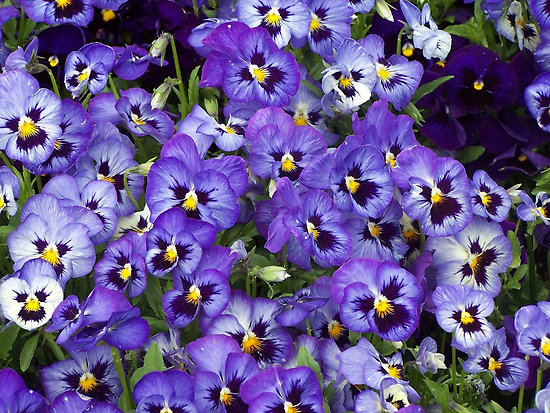
  •  Pansies and violas. pictured at right, are typically the first plants you see popping up in garden centers. That’s because they are the most cold tolerant annual flower, able to take a solid freeze. You will notice once the weather gets warmer they will start looking long and sickly. Just chop them back and let your other plants take over; once fall comes, they should look as good as they did in the spring.
  •  Snapdragons
  •  Alyssums
  •  Calendula (pot marigold)
  •  Lobelia
  •  Dianthus
  •  Forget-me-nots
  •  Nasturtium
If you are planting from seed, be aware that the seedlings are more damaged by frost than plants with true leaves. If have already started your plants indoors or in a hoop house, they need to be hardened off for about two weeks before they are planted in the ground. To do this, simply increase the time the plants spend outside during the day so they can acclimate to the change in temperatures and sunlight.

Good luck and happy planting!!

Alyssa - Garden Center Annuals Manager

Pin us on Pinterest!

Thursday, April 5, 2012

'PJM' Rhododendron, a hardy Minnesota Shrub - Mickman Brothers Garden Center

‘PJM’ Rhododendron, a Northern Treasure
David C. Zlesak, Extension Educator
Article reposted from the University of Minnesota Extension 'Yard and Garden News' 05/15/2008


pjm 1 Plants of ‘PJM’ rhododendron gracing the entrance of a home. David Zlesak

pjm 2 Flowers and foliage of ‘PJM’ rhododendron are richly colored. David Zlesak

pjm 3 'Olga Mezitt' Rhododendron. John Eustice
Shining in the landscapes of Minnesota and other Northern tiered states for decades, the glowing purple/pink blooms of ‘PJM’ Rhododendron are an easily recognizable and much welcomed addition to the spring landscape. Out of all the rhododendron choices for Minnesota, ‘PJM’ is arguably the most widespread, hardy, and adaptable. Due to minimal or no seed set, it tends to set abundant flower buds and blooms prolifically each year. It performs well in partial shade to full sun and has a wide tolerance to soil conditions, although, like most rhododendrons and azaleas, it prefers cool, acidic, well-draining, soils high in organic matter.

History of ‘PJM’
The name comes from the initials of Peter J. Mezitt, founder of Weston Nurseries in Massachusetts. ‘PJM’ is a cross between two rhododendron species- Rhododendron carolinianum and R. dauricum. In 1939, Peter Mezitt heard of some particularly beautiful specimens of R. dauricum in the mountains of China from some visiting missionaries. He arranged to receive some seedlings and among them was a particularly nice plant that was more faithfully evergreen than the others. Peter’s son Edmund worked at the nursery with his father. Using a camel’s hair brush, Edmund put pollen of the select R. dauricum seedling onto R. carolinianum (this was the first cross Edmund ever made). The seedlings were planted out and a few years later, in May of 1945, Peter and Edmund noticed their spectacular blooms, even as young plants. They knew from the beginning that these plants were very special because of their vigor, compact habit, attractive foliage, and beautiful floral display.

Multiple forms of ‘PJM’ Rhododendron exist
Since seedlings are relatively uniform from this cross, what is sold as ‘PJM’ is sometimes derived from recreating the original cross and raising seed. However, some variability exists among the seedlings for flower and foliage color, growth rate, and plant habit. Selections with unique features have been made and are clonally propagated. Some of the clonal selections include ‘Elite’ (little bit later flowering and more upright than typical ‘PJM’), ‘Victor’ (earlier flowering, more compact, and less vigorous than typical ‘PJM’), and ‘Regal’ (vigorous selection with a spreading habit).
Two other hardy cultivars of note from Weston Nurseries include ‘Olga Mezitt’ (sometimes called just ‘Olga’) and ‘Aglo’. They are similar in growth habit and hardiness to ‘PJM’, but the flower color is more pink. Both are named after Peter Mezitt’s wife, Olga. Both share the same species parents, but differ in the direction of the cross (which species served as the female and which as the male). Just as the cross is reversed to produce each cultivar, so is their cultivar name - ‘Aglo’ is Olga’s name spelled backwards.

*This article was reposted from the University of Minnesota Extension 'Yard and Garden News' 05/15/2008

www.mickman.com
Find us on Facebook!
Follow us on Twitter!
Pin us on Pinterest!